
From Data to Insight — Fast, Accurate, Explainable
SentiMetrix delivers AI and machine-learning solutions that transform raw data into meaningful insights for research, healthcare, and industry.
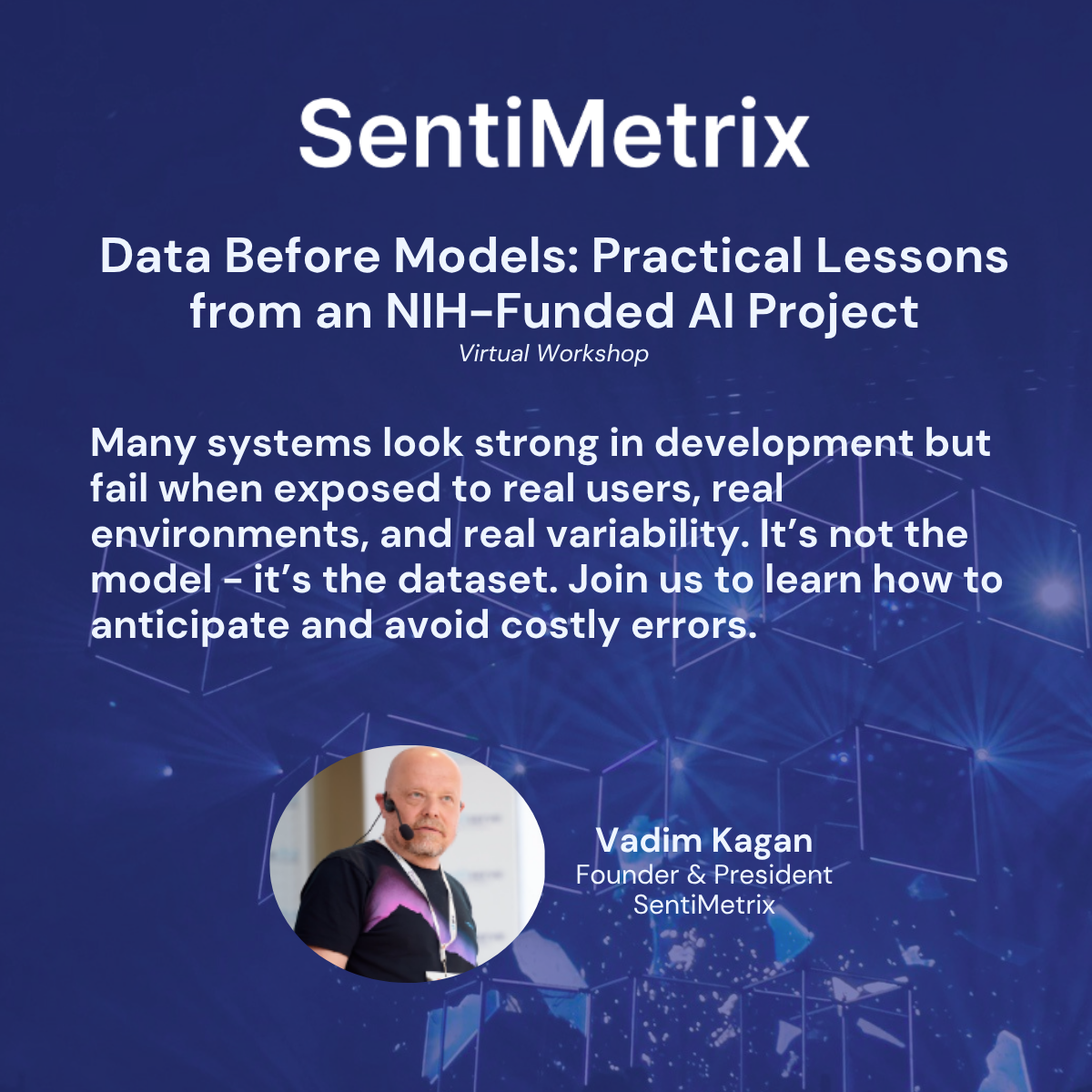
Building AI has never been easier. With foundation models and modern frameworks, teams can develop a working prototype in days. But as experienced innovators know all too well, something changes when those systems meet the real world. The model that worked in the demo suddenly begins to behave unpredictably, and performance numbers that looked impressive become unreliable.
In most cases, the problem is not the model. It is the dataset.
Modern systems - including those built on foundational models - require clean data as a representation for the real world. But collecting and labeling that data can quickly become expensive. This challenge is made worse by overcollection costs caused by teams unsure of how much data they actually need or how to effectively structure it for training.
The good news is that building a balanced, production-ready dataset does not require unlimited data collection. With the right strategy, teams can reduce unnecessary data acquisition, extend existing datasets through augmentation, and design verification workflows that maintain quality without excessive cost.
On Wednesday, April 22nd at 12pm ET, you're invited to join Vadim Kagan, Founder and President of SentiMetrix, for a 20-minute session (followed by Q&A) on how to build balanced, production-ready datasets without overspending to ensure your AI project launches with the accuracy the market demands.
What You'll Learn:
How to determine the right dataset size for your specific task — and why collecting more data is not always the right move
How to design labels that produce consistent annotations
When and how to use augmentation techniques to extend your dataset without degrading model performance
How to design train/validation/test splits that prevent leakage and produce evaluation metrics you can actually trust
Who Should Attend?
Teams building AI-powered products and features
Teams working with real-world data, including video, text, sensors, and clinical records
Teams moving from prototype to production
Teams whose models perform well in the lab but struggle in the field
Technical founders managing lean budgets ahead of a funding or pilot milestone
About the Speaker. Vadim Kagan, SentiMetrix Founder and President, has over 30 years of experience in software and information systems. He has served as Principal Investigator, Co-PI, and Program Manager on DARPA- and U.S. Army MEDCOM–sponsored programs. His work spans behavioral analytics and PTSD-related signal detection, and he has managed the transition of machine learning technologies into deployable operational solutions.
Specializations
Big Data Analytics
Healthcare Applications

Machine Learning

Natural Language Processing

Social Media Analytics
Automated video analysis to make human mobility assessment more accurate and accessible

Why SentiMetrix
Research-Grade Expertise, Product-Grade Execution
We design systems that withstand scientific scrutiny while remaining practical, scalable, and usable in operational environments.
Deep Experience with Human Movement & Behavioral Data
Our work spans physical activity, mobility, posture, and behavior — including video-based and multi-modal data sources that are challenging to analyze reliably.
Built for Validation, Not Just Demonstration
Our solutions are designed to support pilots, external evaluation, and longitudinal use — not just one-off proofs of concept.
Machine Learning Integrated End-to-End
We integrate ML across data pipelines, models, interfaces, and deployment from the start — avoiding fragile, bolt-on approaches.
Comfortable in Regulated and High-Stakes Environments
We regularly support projects operating under IRB review, grant oversight, and healthcare or government constraints.
Specialization: Health, Mobility, and Research Systems
SentiMetrix has deep specialization in building AI-enabled systems for health, physical activity, and mobility research. Our experience includes video-based assessment, standardized activity labeling, longitudinal measurement, and interfaces designed to support scientific validity and clinical relevance.
This specialization informs how we approach system design, validation, and deployment — even when the end product is a general-purpose platform or tool.